Electricity meters – models and usage


Electricity meters – models and usage
Electricity meters play a central role in modern homes, where energy consumption and efficiency are in focus. They make it possible to monitor electricity usage in real time, identify energy guzzlers and optimise electricity consumption. With the development of smart solutions, electricity meters are no longer just a technical requirement, but a tool for gaining an overview and saving money.
In this article, you will get an overview of the most important factors to consider when choosing an electricity meter, as well as an introduction to the different types and brands on the market.
The article presents a wide range of electricity meters – from simple, manual models to advanced, digital solutions. The aim is to provide an overview of functions, features and price ranges so that you can more easily find a model that suits your needs. The information about the products is based on publicly available descriptions from manufacturers and retailers and has been summarised to provide a neutral and informative overview.
Factors to consider when buying an electricity meter
When choosing an electricity meter, it is important to consider functionality, accuracy and area of use. Here are some of the most important factors to consider.
1. Measurement principle and accuracy
Electricity meters can measure electricity consumption in different ways – mechanically, electronically or digitally. Electronic and digital meters usually provide more accurate readings and the possibility of detailed data collection. If you want to monitor consumption in real time, you should choose a model with high measurement accuracy and digital reading.
2. Single- or three-phase measurement
In private homes, single-phase electricity meters are most often used, while three-phase models are used in larger installations or homes with powerful appliances such as heat pumps and electric cars. Make sure to choose an electricity meter that suits your installation type.
3. Communication and data collection
Many modern electricity meters can communicate with other devices via Wi-Fi, Zigbee or Bluetooth. This makes it possible to read consumption via smartphone or computer and integrate the meter into a smart home system. Consider whether you want a model with remote access and data logging.
4. Installation and user-friendliness
Some electricity meters require professional installation, while others can be plugged directly into a wall socket. If you only want to measure the consumption of individual appliances, a plug-in model may be sufficient. For fixed installation in the electrical panel, you should choose a model that meets current safety standards.
5. Price and functionality
The price depends on features and technology. Simple models are inexpensive and easy to use, while advanced smart meters offer detailed consumption analysis and remote control. Think about which features you actually need so that you get the best value for your money.
Products in focus
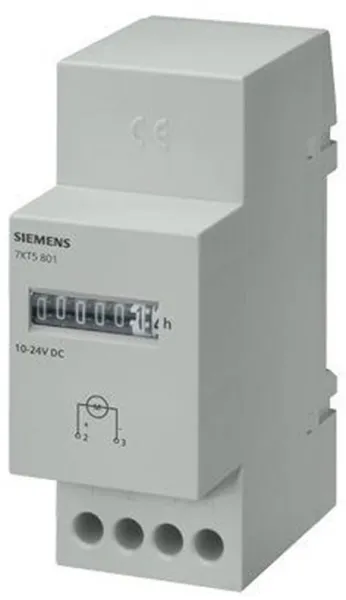
The Siemens Mechanical Hour Counter 230V 60Hz is a compact unit designed to record the total operating time of electrical systems. It works by counting hours when the unit is powered, providing an accurate overview of how long a device or machine has been in use.
The mechanical design makes it particularly suitable for environments where simplicity and operational reliability are prioritised. Since it does not require software or digital configuration, it is easy to install and use in many types of electrical cabinets and control systems.
The hour counter is part of Siemens' 7KT series (model 7KT5807) and is manufactured with a focus on long service life and stable performance. It can be used in both industrial and commercial installations where accurate recording of operating hours is required.
- Mechanical operating counter: Records operating time without the need for digital control.
- 230V, 60Hz: Designed for standard electrical installations with this voltage and frequency.
- Robust construction: Suitable for demanding environments requiring reliable operation.
- Easy installation: Can be integrated directly into cabinets and control systems.
- Long service life: Mechanical design without complex electronic components.
Pros and cons
- Reliable and maintenance-free design
- Easy to install and use
- No need for software or programming
- Suitable for industrial applications
- Lacks advanced features such as data collection or digital reading
- Limited to use at 230V and 60Hz
Pros and cons
Pros
- Reliable and maintenance-free design
- Easy to install and use
- No need for software or programming
- Suitable for industrial applications
Cons
- Lacks advanced features such as data collection or digital reading
- Limited to use at 230V and 60Hz
Pros
- Reliable and maintenance-free design
- Easy to install and use
- No need for software or programming
- Suitable for industrial applications
Cons
- Lacks advanced features such as data collection or digital reading
- Limited to use at 230V and 60Hz
Specifications
- Manufacturer: Siemens
- Model: 7KT5807
- Type: Mechanical hour counter
- Voltage: 230V
- Frequency: 60Hz
- EAN: 4001869311012
- Item number: 2904002
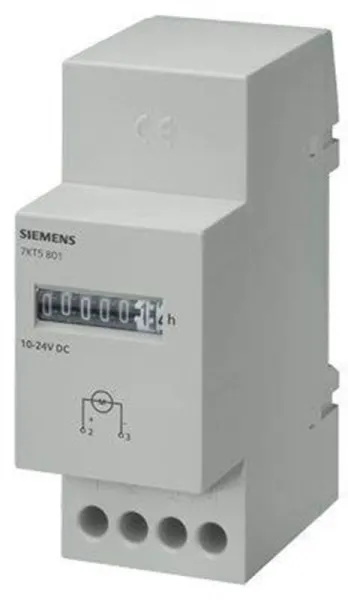
This mechanical timer from Siemens is designed to measure and record operating time in electrical circuits with a supply voltage between 10 and 27 volts DC. It is suitable for use in control cabinets, machines, and other industrial applications where precise time recording is required.
The unit is part of the Siemens 7KT series and comes in a compact format that makes it easy to integrate into existing installations. The mechanical design ensures stable operation without the need for software or external configuration.
With a weight of only 95 grams, the timer is easy to handle and install. It is developed to deliver reliable measurement over a long period, making it suitable for both new and existing installations.
- Supply voltage: 10–27 V DC
- Mechanical construction: Operation without the need for electronics or software
- Measurement function: Records operating time in kWh
- Compact design: Easy to integrate into cabinets and machines
- Low weight: Only 95 grams
Pros and cons
- Reliable and simple mechanical function
- Suitable for industrial and technical installations
- Requires minimal maintenance
- Easy integration into existing systems
- No digital functions or data output
- Limited to DC voltage between 10 and 27 volts
Pros and cons
Pros
- Reliable and simple mechanical function
- Suitable for industrial and technical installations
- Requires minimal maintenance
- Easy integration into existing systems
Cons
- No digital functions or data output
- Limited to DC voltage between 10 and 27 volts
Pros
- Reliable and simple mechanical function
- Suitable for industrial and technical installations
- Requires minimal maintenance
- Easy integration into existing systems
Cons
- No digital functions or data output
- Limited to DC voltage between 10 and 27 volts
Specifications
- Manufacturer: Siemens
- Model: 7KT5801
- Item number: 2904003
- EAN: 4001869310961
- Supply voltage: 10–27 V DC
- Measurement function: Power consumption
- Measurement unit: kWh
- Weight: 95 g
- Product type: Mechanical timer
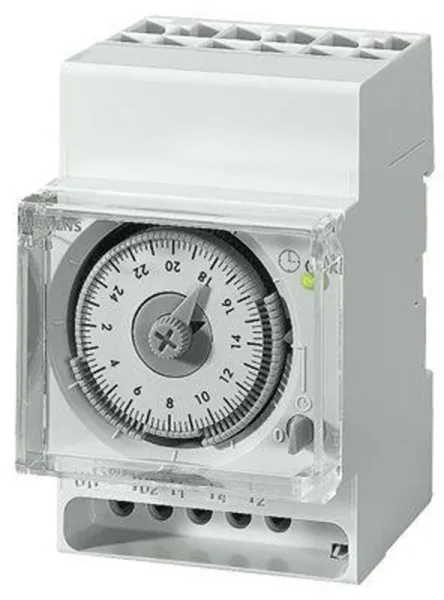
The Siemens Contactor week 1sk 230V/50Hz is a synchronous time relay used to control electrical circuits according to a set time schedule. The unit is intended for installation in electrical panels and is suitable for applications where automatic control of lighting, heating, or other electrical loads is desired.
The contactor operates with an operating voltage of 230 volts at 50 hertz and has a single changeover contact (1SK). The synchronous motor ensures stable and precise timing function, making it suitable for continuous operation in professional installations.
With a compact design of 3 TE (modules), it fits into standard DIN rail installations. The product is part of the Siemens 7LF5300 series, known for reliability and long service life in industrial and commercial environments.
- Synchronous time relay: Provides precise and stable time control.
- Operating voltage 230V/50Hz: Standard for most electrical installations.
- 1 changeover contact: Enables simple circuit control.
- Compact design: 3 TE width for DIN rail mounting.
- Siemens 7LF5300 series: Known for reliability and quality.
Pros and cons
- Reliable and precise time control
- Compact format for panel mounting
- Suitable for automation of fixed installations
- Long service life and stable operation
- Requires fixed installation in electrical panel
- Not suitable for battery operation or mobile applications
Pros and cons
Pros
- Reliable and precise time control
- Compact format for panel mounting
- Suitable for automation of fixed installations
- Long service life and stable operation
Cons
- Requires fixed installation in electrical panel
- Not suitable for battery operation or mobile applications
Pros
- Reliable and precise time control
- Compact format for panel mounting
- Suitable for automation of fixed installations
- Long service life and stable operation
Cons
- Requires fixed installation in electrical panel
- Not suitable for battery operation or mobile applications
Specifications
- Manufacturer: Siemens
- Model: 7LF5300-6
- Item number: 2904009
- EAN: 4001869335759
- Type: Synchronous time relay / contactor
- Operating voltage: 230V / 50Hz
- Contact configuration: 1 changeover contact (1SK)
- Module width: 3 TE
- Measuring function: Power consumption
- Measuring unit: kWh
- Weight: 150 g
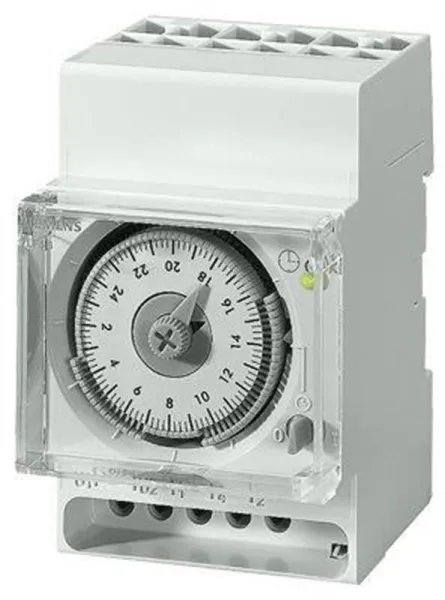
The Siemens Contactor day 1sk 230V/50Hz is a synchronous time relay used for automatic control of electrical circuits. The unit is equipped with a changeover contact and is intended for operation at 230 volts and 50 hertz.
The product is part of Siemens' range of components for panels and enclosures and is developed to deliver stable and precise time control in daily applications. The synchronous motor ensures accurate time function, making it suitable for fixed on/off cycles.
With a weight of 147 grams and a compact design, the contactor is easy to integrate into existing installations. It is a practical choice for controlling lighting, heating, or other electrical systems where repeated time intervals are desired.
- Synchronous time relay: Provides precise and stable time control.
- One changeover contact: Simple and efficient circuit control.
- 230V/50Hz operation: Standard voltage for most installations.
- Compact design: Easy to mount in panels and enclosures.
- Siemens quality: Known for reliability and long service life.
Pros and cons
- Reliable and precise time control
- Compact and lightweight design
- Easy integration into existing panels
- Suitable for daily on/off functions
- Only one changeover contact limits application possibilities
- Requires fixed installation and electrical connection
Pros and cons
Pros
- Reliable and precise time control
- Compact and lightweight design
- Easy integration into existing panels
- Suitable for daily on/off functions
Cons
- Only one changeover contact limits application possibilities
- Requires fixed installation and electrical connection
Pros
- Reliable and precise time control
- Compact and lightweight design
- Easy integration into existing panels
- Suitable for daily on/off functions
Cons
- Only one changeover contact limits application possibilities
- Requires fixed installation and electrical connection
Specifications
- Manufacturer: Siemens
- Model: 7LF5300-5
- Item number: 2904010
- EAN: 4001869335742
- Type: Synchronous time relay with 1 changeover contact
- Operating voltage: 230V / 50Hz
- Measuring function: Power consumption
- Measuring unit: kWh
- Weight: 147 g
Product descriptions
The Siemens Mechanical Hour Counter 230V 60Hz is a compact unit designed to record the total operating time of electrical systems. It works by counting hours when the unit is powered, providing an accurate overview of how long a device or machine has been in use.
The mechanical design makes it particularly suitable for environments where simplicity and operational reliability are prioritised. Since it does not require software or digital configuration, it is easy to install and use in many types of electrical cabinets and control systems.
The hour counter is part of Siemens' 7KT series (model 7KT5807) and is manufactured with a focus on long service life and stable performance. It can be used in both industrial and commercial installations where accurate recording of operating hours is required.
- Mechanical operating counter: Records operating time without the need for digital control.
- 230V, 60Hz: Designed for standard electrical installations with this voltage and frequency.
- Robust construction: Suitable for demanding environments requiring reliable operation.
- Easy installation: Can be integrated directly into cabinets and control systems.
- Long service life: Mechanical design without complex electronic components.
Pros and cons
- Reliable and maintenance-free design
- Easy to install and use
- No need for software or programming
- Suitable for industrial applications
- Lacks advanced features such as data collection or digital reading
- Limited to use at 230V and 60Hz
Pros and cons
Pros
- Reliable and maintenance-free design
- Easy to install and use
- No need for software or programming
- Suitable for industrial applications
Cons
- Lacks advanced features such as data collection or digital reading
- Limited to use at 230V and 60Hz
Pros
- Reliable and maintenance-free design
- Easy to install and use
- No need for software or programming
- Suitable for industrial applications
Cons
- Lacks advanced features such as data collection or digital reading
- Limited to use at 230V and 60Hz
Specifications
- Manufacturer: Siemens
- Model: 7KT5807
- Type: Mechanical hour counter
- Voltage: 230V
- Frequency: 60Hz
- EAN: 4001869311012
- Item number: 2904002
This mechanical timer from Siemens is designed to measure and record operating time in electrical circuits with a supply voltage between 10 and 27 volts DC. It is suitable for use in control cabinets, machines, and other industrial applications where precise time recording is required.
The unit is part of the Siemens 7KT series and comes in a compact format that makes it easy to integrate into existing installations. The mechanical design ensures stable operation without the need for software or external configuration.
With a weight of only 95 grams, the timer is easy to handle and install. It is developed to deliver reliable measurement over a long period, making it suitable for both new and existing installations.
- Supply voltage: 10–27 V DC
- Mechanical construction: Operation without the need for electronics or software
- Measurement function: Records operating time in kWh
- Compact design: Easy to integrate into cabinets and machines
- Low weight: Only 95 grams
Pros and cons
- Reliable and simple mechanical function
- Suitable for industrial and technical installations
- Requires minimal maintenance
- Easy integration into existing systems
- No digital functions or data output
- Limited to DC voltage between 10 and 27 volts
Pros and cons
Pros
- Reliable and simple mechanical function
- Suitable for industrial and technical installations
- Requires minimal maintenance
- Easy integration into existing systems
Cons
- No digital functions or data output
- Limited to DC voltage between 10 and 27 volts
Pros
- Reliable and simple mechanical function
- Suitable for industrial and technical installations
- Requires minimal maintenance
- Easy integration into existing systems
Cons
- No digital functions or data output
- Limited to DC voltage between 10 and 27 volts
Specifications
- Manufacturer: Siemens
- Model: 7KT5801
- Item number: 2904003
- EAN: 4001869310961
- Supply voltage: 10–27 V DC
- Measurement function: Power consumption
- Measurement unit: kWh
- Weight: 95 g
- Product type: Mechanical timer
The Siemens Contactor week 1sk 230V/50Hz is a synchronous time relay used to control electrical circuits according to a set time schedule. The unit is intended for installation in electrical panels and is suitable for applications where automatic control of lighting, heating, or other electrical loads is desired.
The contactor operates with an operating voltage of 230 volts at 50 hertz and has a single changeover contact (1SK). The synchronous motor ensures stable and precise timing function, making it suitable for continuous operation in professional installations.
With a compact design of 3 TE (modules), it fits into standard DIN rail installations. The product is part of the Siemens 7LF5300 series, known for reliability and long service life in industrial and commercial environments.
- Synchronous time relay: Provides precise and stable time control.
- Operating voltage 230V/50Hz: Standard for most electrical installations.
- 1 changeover contact: Enables simple circuit control.
- Compact design: 3 TE width for DIN rail mounting.
- Siemens 7LF5300 series: Known for reliability and quality.
Pros and cons
- Reliable and precise time control
- Compact format for panel mounting
- Suitable for automation of fixed installations
- Long service life and stable operation
- Requires fixed installation in electrical panel
- Not suitable for battery operation or mobile applications
Pros and cons
Pros
- Reliable and precise time control
- Compact format for panel mounting
- Suitable for automation of fixed installations
- Long service life and stable operation
Cons
- Requires fixed installation in electrical panel
- Not suitable for battery operation or mobile applications
Pros
- Reliable and precise time control
- Compact format for panel mounting
- Suitable for automation of fixed installations
- Long service life and stable operation
Cons
- Requires fixed installation in electrical panel
- Not suitable for battery operation or mobile applications
Specifications
- Manufacturer: Siemens
- Model: 7LF5300-6
- Item number: 2904009
- EAN: 4001869335759
- Type: Synchronous time relay / contactor
- Operating voltage: 230V / 50Hz
- Contact configuration: 1 changeover contact (1SK)
- Module width: 3 TE
- Measuring function: Power consumption
- Measuring unit: kWh
- Weight: 150 g
The Siemens Contactor day 1sk 230V/50Hz is a synchronous time relay used for automatic control of electrical circuits. The unit is equipped with a changeover contact and is intended for operation at 230 volts and 50 hertz.
The product is part of Siemens' range of components for panels and enclosures and is developed to deliver stable and precise time control in daily applications. The synchronous motor ensures accurate time function, making it suitable for fixed on/off cycles.
With a weight of 147 grams and a compact design, the contactor is easy to integrate into existing installations. It is a practical choice for controlling lighting, heating, or other electrical systems where repeated time intervals are desired.
- Synchronous time relay: Provides precise and stable time control.
- One changeover contact: Simple and efficient circuit control.
- 230V/50Hz operation: Standard voltage for most installations.
- Compact design: Easy to mount in panels and enclosures.
- Siemens quality: Known for reliability and long service life.
Pros and cons
- Reliable and precise time control
- Compact and lightweight design
- Easy integration into existing panels
- Suitable for daily on/off functions
- Only one changeover contact limits application possibilities
- Requires fixed installation and electrical connection
Pros and cons
Pros
- Reliable and precise time control
- Compact and lightweight design
- Easy integration into existing panels
- Suitable for daily on/off functions
Cons
- Only one changeover contact limits application possibilities
- Requires fixed installation and electrical connection
Pros
- Reliable and precise time control
- Compact and lightweight design
- Easy integration into existing panels
- Suitable for daily on/off functions
Cons
- Only one changeover contact limits application possibilities
- Requires fixed installation and electrical connection
Specifications
- Manufacturer: Siemens
- Model: 7LF5300-5
- Item number: 2904010
- EAN: 4001869335742
- Type: Synchronous time relay with 1 changeover contact
- Operating voltage: 230V / 50Hz
- Measuring function: Power consumption
- Measuring unit: kWh
- Weight: 147 g
Different types of electricity meters
Electricity meters come in many variants that differ in function, technology and area of use. Here are the most common types.
1. Mechanical electricity meters
The classic electricity meters with a rotating disc are still found in older installations. They are robust and reliable but lack the ability for digital reading and precise data collection. They are rarely used in new installations.
2. Electronic electricity meters
Electronic meters use sensors to record electricity consumption and display data on a digital screen. They are more accurate than mechanical models and can often be connected to external systems for data collection.
3. Smart meters
Smart meters are the latest generation of electricity meters. They can automatically send consumption data to the electricity company and give the user access to detailed information via an app or web portal. They are ideal for homeowners who want full insight into their energy consumption.
4. Plug-in electricity meters
These small, portable meters are plugged directly into the wall socket and are used to measure the consumption of individual appliances. They are practical for identifying energy guzzlers in the home and require no installation.
5. Sub-meters
Sub-meters are used to measure consumption in specific parts of an installation, for example in a flat, a rental room or a solar power system. They provide a detailed picture of where the electricity is used.
Different brands of electricity meters
The market for electricity meters includes many manufacturers, each with their own focus areas and technological strengths.
Kamstrup
Kamstrup is a Danish manufacturer known for its advanced smart meters for both private and commercial use. Their products combine high precision with modern communication technology and long service life.
Schneider Electric
Schneider Electric offers a wide range of electricity meters for both single-phase and three-phase installations. The brand focuses on energy efficiency, safety and integration into larger control systems.
Carlo Gavazzi
Carlo Gavazzi manufactures measuring equipment for both private and industrial purposes. Their electricity meters are known for flexibility, modular design and the ability to communicate via multiple protocols.
Siemens
Siemens offers reliable and accurate electricity meters with a focus on quality and user-friendliness. Many models support data collection and integration into building automation systems.
Eastron
Eastron provides affordable electricity meters with high accuracy and a wide range of models. They are popular in both private installations and smaller commercial projects where simple monitoring of consumption is desired.
Frequently asked questions
What is the difference between a regular electricity meter and a smart meter?
A regular electricity meter only shows the total consumption, while a smart meter can send data automatically and provide detailed insight into consumption hour by hour. Smart meters make it easier to monitor and reduce energy consumption.
Can I install an electricity meter myself?
You can connect plug-in electricity meters yourself, but fixed electricity meters must be installed by an authorised electrician to ensure correct measurement and compliance with safety regulations.
How do I read my electricity meter?
Digital electricity meters display consumption directly on the screen, often in kilowatt hours (kWh). Smart meters can also be read via an app or web portal, where you can see historical data and consumption patterns.
How accurate are electricity meters?
Most modern electricity meters have an accuracy of ±1% or better. To ensure correct measurement, you should choose a model that is MID-approved (Measuring Instruments Directive).
Can an electricity meter help me save electricity?
Yes, by providing insight into consumption, you can identify where and when you use the most electricity. This makes it easier to change habits and reduce unnecessary energy consumption.